Why Potato Chips Remain a Retail Staple in India
Potato chips are one of the most consistently purchased snack categories in Indian retail — sold in kirana stores, supermarkets, and roadside stalls alike. Unlike seasonal or festival-driven snacks, chips are bought year-round, in small ₹5-₹10 packs as well as larger family packs. For retailers, this makes chips a dependable, high-turnover category rather than a one-off impulse product. For manufacturers, it means consistent demand — but also constant competition on taste, price, and shelf presence.
What Makes a Good Potato Chips Manufacturer
Not all potato chips are made the same way. A reliable manufacturer typically checks these boxes:
- Real potato content — some low-cost chips use potato flakes or starch blends instead of whole potato slices, which affects taste and texture
- FSSAI certification — a legal requirement for any food manufacturer in India, and a basic trust signal for buyers
- Consistent batch quality — the same product should taste the same whether it’s bought this week or next month
- Stable supply chain — for retailers and distributors, delayed dispatch or inconsistent stock is a bigger problem than price
- Flexible order sizes — from small retail cartons to bulk wholesale, distributor, or private-label quantities
Types of Potato Chips Manufactured in India
Most Indian potato chips manufacturers produce a core set of flavours to match regional taste preferences:
- Plain Salted — the base, unflavoured potato chip
- Cream & Onion — a mild, widely popular flavour across age groups
- Tangy Tomato — a tangy, slightly sweet-sour profile
- Masala/Magic Masala — spice-forward, popular in North India
Manufacturers that offer this full flavour range under one roof make it easier for retailers to stock a complete chips section from a single supplier, rather than sourcing different flavours from different brands.
How Potato Chips Are Manufactured
The basic process is fairly standard across manufacturers in India: potatoes are washed, peeled, and sliced thin, then fried (or in some cases baked) until crisp, seasoned with the relevant flavor mix, and packed in moisture-sealed pouches to preserve shelf life—typically around 4-6 months. What differs between manufacturers is oil quality, frying consistency, seasoning balance, and quality control at each stage—which is where taste and repeat-purchase behavior actually get decided.
Packaging and Shelf Life Considerations
Packaging plays a bigger role than most buyers realize. Chips are sensitive to moisture and oxygen — poor sealing leads to sogginess, rancid oil taste, or shortened shelf life. Good manufacturers use nitrogen-flushed or moisture-barrier pouches that keep chips crisp for the full stated shelf life, which typically ranges from 4 to 6 months. For distributors managing multi-city supply chains, this shelf life window is what allows enough buffer for warehousing, transit, and retail display without spoilage risk.
Private Label and Contract Manufacturing
Beyond supplying their own branded chips, some manufacturers also offer private label or contract manufacturing — producing chips under a retailer’s or a new brand’s own packaging and label. This is a common route for entrepreneurs entering the snack business without setting up their own factory. If this is relevant to your business, it’s worth asking a manufacturer directly whether they support private label orders, what the minimum order quantity is, and what lead time to expect.
How to Choose the Right Potato Chips Manufacturer
If you’re a retailer, distributor, or brand owner evaluating manufacturers, ask these questions before committing:
- Is the manufacturer FSSAI licensed? Ask for the license number directly.
- Do they use real potatoes or substitutes? This affects both taste and marketing claims.
- What’s their minimum order quantity (MOQ)? Important for small retailers vs. bulk distributors.
- Can they support private label or contract manufacturing? Relevant if you’re building your own snack brand.
- Where is the facility located? Closer manufacturing means fresher stock and faster restocking — a real advantage in fast-moving retail categories like chips.
- What’s their pricing structure across pack sizes? Retailers often need a spread from ₹5 impulse packs to larger family packs.
Samboy Snacks — A Potato Chips Manufacturer in Delhi NCR
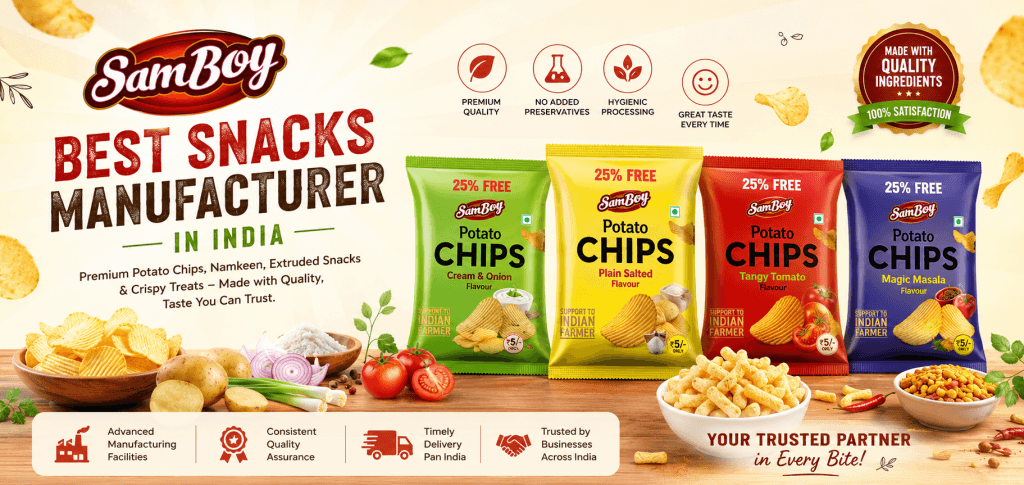
Samboy Snacks manufactures potato chips — Cream & Onion, Plain Salted, Tangy Tomato, and Magic Masala — from its facility in Sector 31, Faridabad, Haryana. The company uses 100% real potatoes, with retail pricing starting at ₹5 per pack, and supplies retailers, wholesalers, and distributors across Delhi, Gurgaon, Noida, Ghaziabad, and Faridabad.
Being based directly in Delhi NCR gives Samboy a practical advantage for buyers in the region: shorter transit times, faster restocking, and a direct manufacturer-to-retailer relationship without multiple middlemen in the supply chain.
Why Location Matters — Potato Chips Manufacturer in Delhi NCR
For retailers and distributors specifically in Delhi NCR, sourcing from a locally-based manufacturer like Samboy Snacks (Faridabad) reduces delivery lead time compared to manufacturers based further away in other states. This matters most for high-turnover, low-price products like chips, where frequent restocking is routine rather than occasional. A local manufacturing base also means retailers can visit the facility, build a direct relationship, and resolve supply issues faster than with an out-of-state supplier.